Continuous Audit Readiness vs Periodic Compliance: What Scales Better for Modern GRC?
-
 Balachandran Sivakumar
 - 15 Jun, 2026
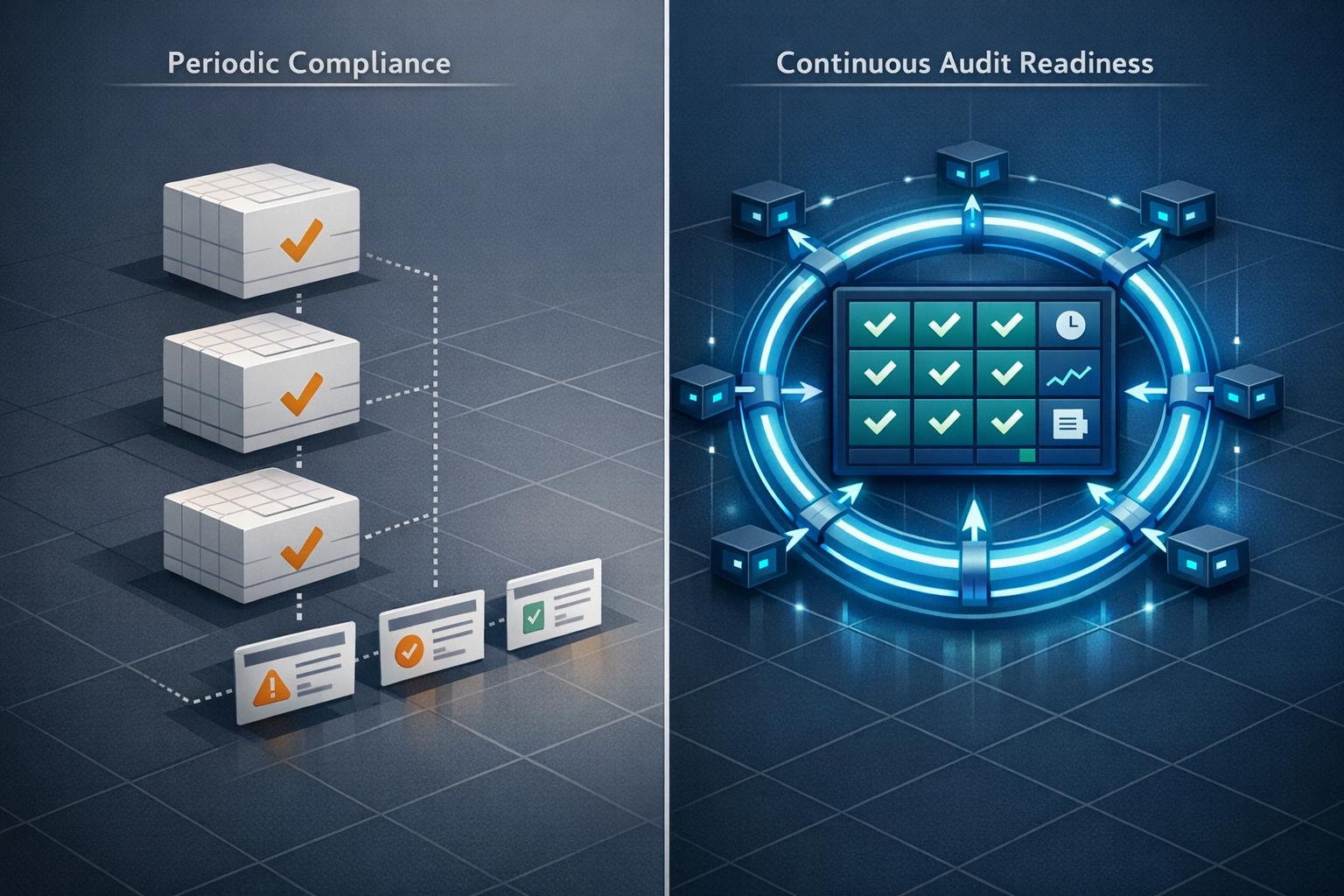
Continuous audit readiness is redefining compliance for 2026. While periodic compliance relies on manual, time-bound efforts, continuous audit readiness automates compliance tasks, ensuring organisations are always prepared for audits. This real-time approach is better suited for handling multiple frameworks, faster risk detection, and scaling operations.
Key Takeaways
- Periodic Compliance: Relies on manual, snapshot-based reviews before audits. High effort, delayed risk detection, and limited scalability.
- Continuous Audit Readiness: Automates evidence collection, monitors controls in real time, and ensures compliance is always verifiable. Saves time, reduces costs, and improves risk management.
- Why It Matters Now: Regulations like PCI DSS v4.0 and NIS2 demand ongoing monitoring and faster incident reporting. Periodic methods can’t keep up with these expectations.
Quick Comparison
| Feature | Periodic Compliance | Continuous Audit Readiness |
|---|---|---|
| Evidence Collection | Manual | Automated |
| Risk Detection | Delayed (weeks/months) | Real time (minutes/hours) |
| Audit Preparation Time | 8-10 weeks | 2-3 weeks |
| Cost Pattern | Spikes during audits | Steady operational costs |
| Scalability | Limited by manual work | Scales with automation |
For organisations juggling multiple frameworks or facing complex regulatory requirements, continuous audit readiness is the practical way forward. It reduces manual effort, ensures faster compliance, and mitigates risks effectively.
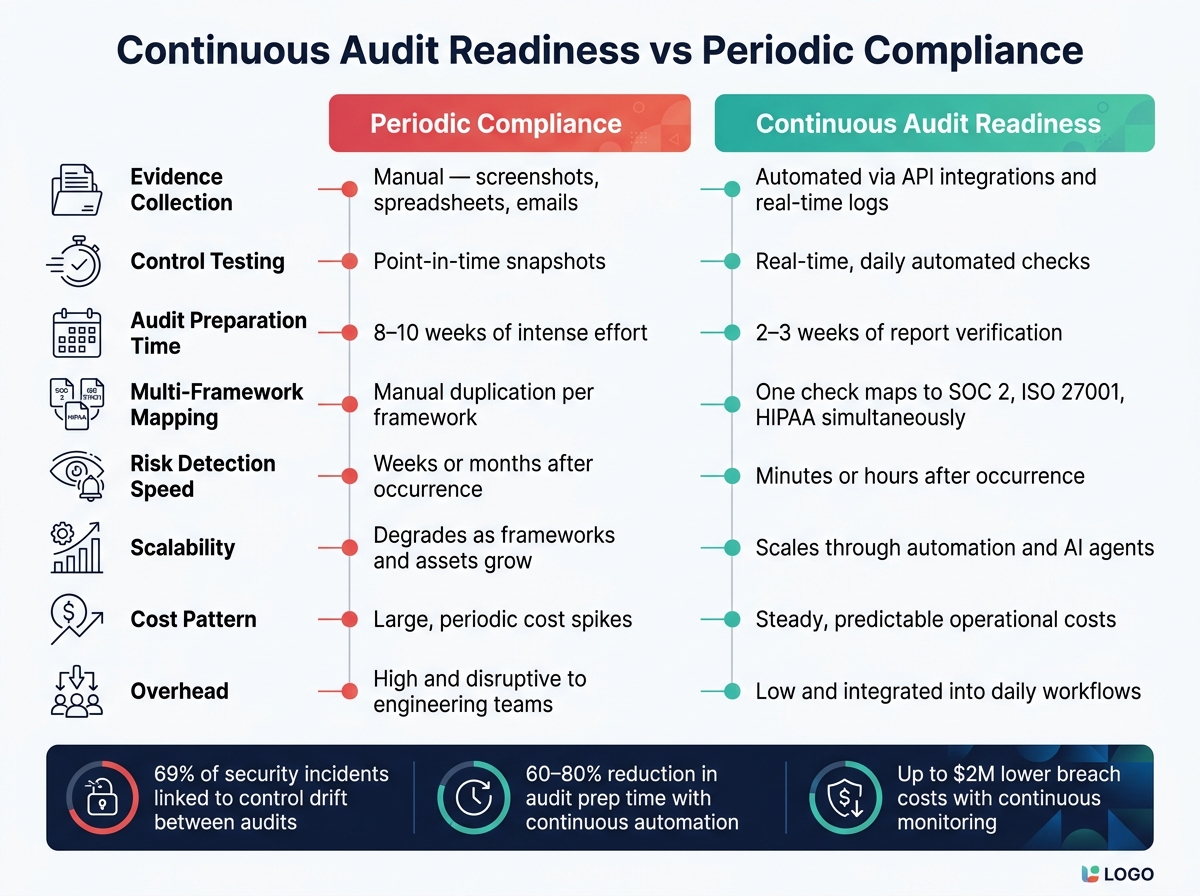
Continuous Audit Readiness vs Periodic Compliance: Key Differences
How Continuous Audit Readiness and Periodic Compliance Differ
In today’s GRC (Governance, Risk, and Compliance) landscape, where scalability is crucial, the approach to compliance can significantly impact operational efficiency. The key difference between continuous audit readiness and periodic compliance lies in how compliance activities are executed daily. Periodic compliance views audits as isolated events with defined start and end points. In contrast, continuous audit readiness treats compliance as an ongoing, integrated process.
“Traditional compliance answers the question: ‘Were we compliant on this specific date?’ Continuous compliance answers the question: ‘Are we compliant right now?’” - Dana Dimoiu, Content Creator, Tekpon
Comparison Table: Continuous Audit Readiness vs Periodic Compliance
| Dimension | Periodic Compliance | Continuous Audit Readiness |
|---|---|---|
| Evidence Collection | Manual - screenshots, spreadsheets, emails | Automated via API integrations and real-time logs |
| Control Testing | Point-in-time snapshots | Real-time, daily automated checks |
| Audit Preparation | 8-10 week “fire drill” | 2-3 weeks of report verification |
| Multi-Framework Mapping | Manual duplication for each framework | One check satisfies SOC 2, ISO 27001, HIPAA simultaneously |
| Overhead | High and disruptive to engineering teams | Low and integrated into daily workflows |
| Risk Detection Speed | Weeks or months after occurrence | Minutes or hours after occurrence |
| Scalability | Degrades as frameworks and assets grow | Scales through automation and AI agents |
| Cost Pattern | Large, periodic cost spikes | Steady, predictable operational cost |
These distinctions have real-world implications for how organisations manage compliance.
Key Differences in Execution
The operational realities of these two approaches further highlight their differences. With periodic compliance, evidence collection is often neglected until an audit looms. This reactive process relies heavily on manual inputs, like spreadsheets and screenshots, to piece together a historical record. Engineers are pulled away from their core responsibilities to recreate compliance documentation, often under tight deadlines.
“The snapshot ages the moment it is taken. Controls drift. Configurations change. New exposures surface.” - Insight Assurance
Periodic compliance has inherent risks. Snapshots of compliance are static and quickly become outdated as configurations evolve and controls drift. This lag can leave organisations exposed; control failures might go unnoticed for months, increasing vulnerability. Alarmingly, 69% of security incidents are linked to control drift between audits, and the average breach lifecycle globally can last up to 241 days.
On the other hand, continuous audit readiness eliminates these challenges. Evidence is gathered automatically and in real time, using platforms like CISOGenie. These tools leverage AI to integrate signals from cloud providers, identity platforms, and HR systems, ensuring that compliance data is always up to date. When auditors request evidence, it’s already prepared - no last-minute scrambling required.
Periodic audits can take up to 8-10 weeks of intense effort, disrupting workflows. In contrast, continuous readiness spreads compliance tasks evenly throughout the year, reducing the final verification phase to just 2-3 weeks. For lean GRC teams juggling multiple frameworks, this shift not only saves time but also supports seamless scalability in modern compliance environments.
Why Periodic Compliance Struggles to Scale
Periodic compliance might work for limited frameworks, but its reliance on manual processes and delayed risk detection makes it ill-suited for modern, complex environments. As businesses grow - adding cloud platforms, vendors, and regulatory requirements - the cracks in this approach become impossible to overlook.
Manual Workflows and Repeated Effort Across Frameworks
One of the biggest hurdles is the sheer amount of manual labour involved. When compliance is treated as an occasional task, evidence collection happens in intense bursts. Teams pull logs from various departments, often relying on manual exports and email chains. In 2026, 58% of organisations reported spending over 2,000 person-hours annually on manual evidence collection. Additionally, 53% had to dedicate a full-time employee just to manage this process.
The problem worsens when multiple frameworks are involved. Companies juggling SOC 2, ISO 27001, and GDPR often end up duplicating work - running separate evidence collection processes, maintaining spreadsheets, and addressing overlapping control requirements. Gabrielle Hovendon from RegScale aptly describes the issue:
“The spreadsheet is the symptom. The disease is the operational model that treats compliance as a periodic, manual, human-intensive exercise.”
This approach drains resources, leaving teams with little time for proactive risk management or broader security initiatives. The heavy reliance on manual work not only limits efficiency but also introduces risks, as highlighted next.
Delayed Risk Detection and Audit Gaps
Periodic compliance leaves organisations vulnerable to risks that go unnoticed between review cycles. Misconfigurations or control failures can linger for months. Considering that the average time from vulnerability disclosure to exploitation is now under 5 days, periodic reviews simply can’t keep up.
In fact, 83% of organisations report moderate or major delays in meeting regulatory requirements due to manual compliance processes. These delays can be costly. Companies with low compliance maturity face data breach costs that are nearly Rs. 16.4 crore, around $2 million, higher than those with automated, continuous monitoring systems. Under stricter regulations like NIS2, senior executives can even be held personally accountable for negligence in risk management, making these gaps not just operational risks but also legal liabilities.
Third-Party Oversight Without Continuous Visibility
Vendor risk management is where periodic compliance falls particularly short. Most third-party assessments are conducted annually - a questionnaire is sent, responses are reviewed, and the box is checked. But vendors frequently update configurations, onboard new subprocessors, or adjust access permissions throughout the year. If a vendor makes a change in March but isn’t reviewed until January, that leaves a 10-month window of potential exposure.
Periodic reviews only provide a snapshot of a vendor’s security posture. For vendors handling sensitive data or critical systems, this lack of continuous visibility is a serious issue. Regulators are increasingly expecting organisations to maintain ongoing oversight, especially for high-risk vendors, making periodic compliance inadequate for today’s expectations.
Why Continuous Audit Readiness Scales Better
Continuous audit readiness transforms compliance from a periodic, reactive task into an always-on process. This change directly tackles the inefficiencies that plague traditional compliance methods.
Real-Time Evidence Collection and Risk Detection
With continuous audit readiness, evidence like access logs, configuration changes, or training records is automatically collected, timestamped, and validated during day-to-day operations. This creates a dynamic, real-time feed instead of relying on outdated snapshots. For instance, if an S3 bucket’s permissions are altered or a contractor’s access isn’t revoked, the system flags it within minutes, not months. By addressing these issues early, organisations can fix minor problems before they escalate into audit findings or security breaches.
This real-time approach streamlines compliance workflows, integrating them more seamlessly into daily operations.
Automated Efficiency in Compliance Workflows
Automation delivers measurable time and cost savings. Companies leveraging continuous compliance automation can cut audit preparation time by 60% to 80%, reducing what used to take 8-10 weeks to just 2-3 weeks of structured review. Modern GRC platforms streamline this process by pulling data from over 100 sources - like AWS, Okta, GitHub, and Workday - through native API integrations. This ensures that evidence is collected continuously, eliminating the need for manual follow-ups.
As Shweta Dhole from TrustCloud explains:
“Continuous compliance is not about drowning teams in dashboards… It is about making control performance visible throughout the year so that evidence accumulates naturally.”
Automation doesn’t just save time; it also reduces costs. Organisations with advanced security automation save an average of Rs. 1.57 crore, or $1.9 million, per breach compared to those without it. Additionally, compliance-related expenses can drop by up to 40% through automated oversight.
Beyond efficiency, automation simplifies multi-framework compliance, making the audit process even smoother.
Simpler Audit Preparation and Multi-Framework Mapping
One of the standout benefits is the ability to handle multi-framework compliance effortlessly. Instead of conducting separate evidence collection for frameworks like SOC 2, ISO 27001, and HIPAA, a single automated check - such as an access review - can simultaneously map to all relevant controls across multiple frameworks. This “one mapping, multiple frameworks” approach eliminates the repetitive work that makes traditional compliance so resource-heavy.
For teams working through SOC 2 readiness, CISOGenie for SOC 2 helps connect the same evidence workflows to control ownership, audit narratives, and ongoing monitoring.
Tools like CISOGenie enable cross-mapping across more than 35 global frameworks. As organisations adopt new regulations, the additional work remains minimal. This means audit preparation shifts from reconstructing past actions to an ongoing process where evidence is always organised, timestamped, and ready for auditors - often available in minutes instead of weeks.
How to Implement Continuous Audit Readiness in Your Organisation
Shifting from periodic compliance checks to continuous audit readiness can redefine how your organisation handles daily compliance tasks.
Core Components You Need in Place
Start by pinpointing your audit challenges - such as access reviews, asset inventories, or change logs - and determine which processes can be automated.
Here are four key elements that form the backbone of continuous audit readiness:
- A unified control library: Combine overlapping requirements from frameworks like SOC 2, ISO 27001, and GDPR into a single set of controls. For instance, implementing multi-factor authentication (MFA) can fulfil multiple compliance needs, reducing duplication and effort.
- Automated evidence pipelines: Say goodbye to manual tasks like taking screenshots or updating spreadsheets. Instead, APIs can connect to systems like AWS, Azure, Okta, or Jira to automatically and continuously collect timestamped evidence.
- Distributed control ownership: Assign specific responsibilities to relevant teams. For example, Engineering can handle access logs, HR can manage onboarding records, and Legal can oversee contract reviews. This ensures accountability and keeps evidence up to date.
- A risk-led operating model: Link your controls to a dynamic risk register that updates in real time. This gives leadership an accurate, up-to-date view of risks rather than relying on static, annual assessments.
This approach shifts compliance from being a periodic exercise to a system of ongoing, real-time validation. To test your readiness, conduct mid-year audit drills. If retrieving evidence still takes more than a few minutes, it’s a sign that your processes need further automation.
Once these foundational elements are in place, AI can take your compliance efforts to the next level.
Using AI and Automation to Enable Continuous Readiness
AI plays a crucial role in making continuous compliance more efficient. By automating tasks like log reviews and follow-ups with control owners, AI agents can monitor your systems 24/7. They flag issues such as configuration drift, orphaned accounts, or missing documentation as part of routine maintenance.
For instance, a fintech firm with 60 employees used Terraform and Open Policy Agent (OPA) to automate S3 encryption and enforce MFA. With AI tools summarising CI logs and drafting control narratives, they managed to cut audit preparation time from eight weeks to just three.
Platforms like CISOGenie are designed specifically for this purpose. As an AI-driven GRC platform, it automates evidence collection and validation across more than 35 global frameworks. It also profiles risks in real time and maps single control checks to multiple frameworks. This is especially helpful for Indian organisations juggling ISO 27001, SOC 2, and industry-specific regulations from SEBI or RBI.
Beyond gathering evidence, AI can reduce alert fatigue by prioritising failures based on their criticality and potential impact. This ensures that your remediation efforts focus on the most pressing risks.
With these tools in place, compliance becomes a natural part of daily operations. Evidence is collected continuously, controls are monitored in real time, and when an auditor requests proof, it’s ready in minutes instead of weeks.
Choosing the Right Approach for Your Organisation
There’s no one-size-fits-all solution when it comes to compliance strategies. The best approach for your organisation depends on factors like your team size, the number of frameworks you manage, the pace of infrastructure changes, and how much disruption your teams can handle during audits. Let’s break down when each approach makes sense and what trade-offs you might face.
When Periodic Compliance Still Works
Periodic compliance can be a practical choice for smaller organisations with limited control environments and just one or two frameworks to manage - like ISO 27001 or a basic NIST CSF tier 2 assessment. For instance, companies with fewer than 20 employees can often manage first-year compliance costs, which typically range between Rs. 25 lakh and Rs. 67 lakh, without needing continuous monitoring.
When Continuous Audit Readiness Is the Better Fit
For companies with a broader compliance scope, periodic checks may no longer cut it. If you’re in fintech, healthtech, or enterprise SaaS and need to handle overlapping requirements - such as SOC 2 Type II, ISO 27001, RBI or SEBI guidelines, or even DORA and GDPR for global operations - periodic compliance snapshots can leave you exposed.
Here’s why: 69% of security incidents happen because controls drift between audit cycles, and attackers are getting faster - vulnerabilities are now exploited in under five days on average. Beyond the risks, there’s also a business angle. With 60% of enterprise buyers demanding third-party compliance attestations before signing contracts, being audit-ready at all times can directly impact your revenue.
Trade-Offs to Weigh Before Deciding
While continuous audit readiness offers clear benefits, it comes with its own challenges. Setting it up involves significant effort - integrating APIs, assigning control ownership, and embedding compliance checks into CI/CD pipelines. Without proper planning and cultural support, these measures could be seen as bottlenecks to deployment. Another concern is alert fatigue; teams may become overwhelmed by low-priority alerts unless severity scoring is implemented effectively.
Still, the long-term benefits are hard to ignore. Continuous monitoring can cut compliance costs by up to 40%, and automating evidence collection can reduce manual work in a GRC programme by 50-70%. Instead of dealing with disruptive spikes during audit seasons, you’ll have a steady and predictable compliance process that’s easier to budget and manage.
To ease the transition, consider a phased “crawl-walk-run” approach. Start by replacing spreadsheets with a dedicated GRC platform. Then, automate the 20 most time-consuming controls, such as access reviews, endpoint compliance, and cloud configurations. Finally, expand automation to cover your entire control catalogue. This step-by-step method helps minimise disruption while laying the groundwork for scalable, efficient compliance operations in today’s demanding regulatory environment.
Conclusion: Picking the GRC Model That Fits How You Work
The main distinction between periodic compliance and continuous audit readiness lies in when issues are identified. With periodic compliance, problems can linger unnoticed for months, while continuous audit readiness flags them within minutes. This difference is critical, especially since control drift is a major factor behind costly breaches - a challenge that isn’t just operational but also financial.
The numbers highlight the serious consequences of delayed detection. Choosing the right model depends on your organisation’s needs and current setup. For instance, a 15-person SaaS startup managing a single ISO 27001 scope will have very different requirements compared to a 500-person fintech navigating SOC 2 Type II, RBI guidelines, and DORA mandates. Ask yourself: if an auditor showed up tomorrow, how quickly could you provide the required evidence? If the answer is “weeks”, you’re still operating in a periodic compliance mode, regardless of what your tools might suggest.
When control performance is monitored consistently throughout the year, evidence builds up naturally - no more scrambling at the last minute. This shift not only reduces stress for compliance teams but also makes the audit process smoother for everyone involved.
Additionally, as regulatory demands grow - with frameworks like NIS2 introducing personal executive liability - organisations with continuous monitoring enjoy a clear financial edge. They can cut data breach costs by nearly $2 million, approximately Rs. 16.6 crores, compared to those with lower compliance maturity. That’s a tangible advantage with real-world implications.
Ultimately, the goal is to create a compliance programme that works hand-in-hand with your business. Start where you are today, automate the processes causing the most headaches, and aim for a system where audit readiness becomes a natural byproduct of your team’s daily work. This strategy not only simplifies compliance but also strengthens your organisation’s overall operations over time.
FAQs
What should we automate first to move from periodic compliance to continuous audit readiness?
To move towards continuous audit readiness, the first step is automating evidence collection from reliable sources. Integrate your GRC platform with essential infrastructure to automatically gather data such as MFA enforcement status, access review logs, logging configurations, backup policy compliance, and vulnerability scan results.
Following this, implement automated control monitoring to spot configuration changes as they happen. This ensures audit-ready records are consistently available, while significantly cutting down on manual work.
How do we prove continuous compliance to auditors without creating more work for engineering?
Proving compliance doesn’t have to be a manual, time-consuming process. By automating evidence collection with an infrastructure-led approach, you can streamline the entire workflow. Tools like AWS Config or API-driven integrations can pull data directly from your cloud environments, identity providers, and version control systems.
The key is mapping these data sources to relevant controls. Once that’s done, you can auto-generate timestamped, signed evidence packs. This not only cuts down on the need for manual preparation but also gives auditors real-time access to live evidence. The result? A lighter workload for your engineering team and a more efficient compliance process.
How does continuous monitoring support vendor risk management across SOC 2 and ISO 27001?
Continuous monitoring transforms vendor risk management from outdated, static questionnaires to a dynamic, real-time approach. AI-powered platforms like CISOGenie leverage autonomous agents to interact with APIs, ensuring constant tracking of third-party security measures. This process automatically captures and timestamps evidence, aligning it with shared controls across frameworks such as SOC 2 and ISO 27001. The result? A transparent and always-current view of your vendor ecosystem’s security posture.